
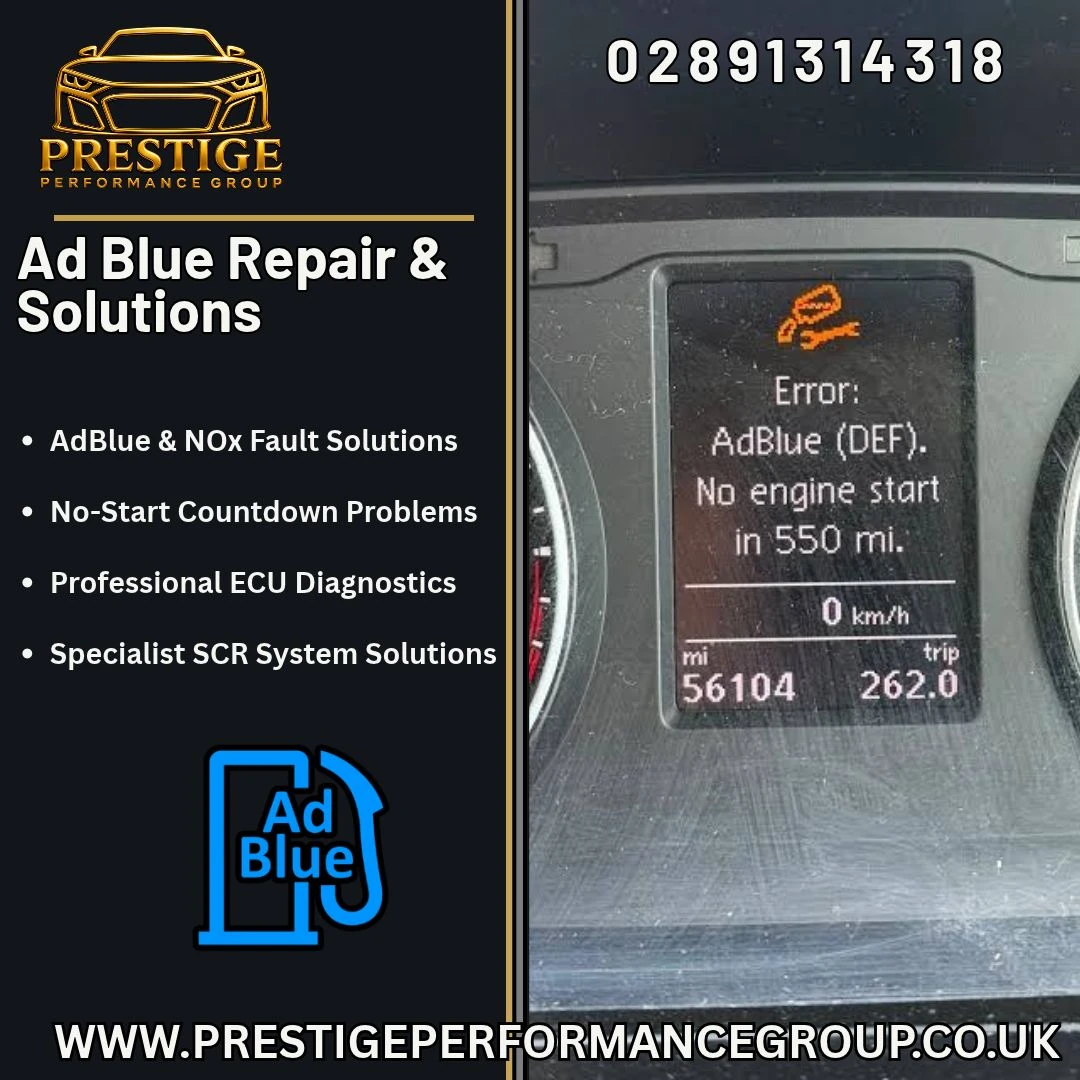
An AdBlue warning can be unsettling, particularly when the dashboard adds a countdown telling you the engine will not restart. You may have topped up the tank already, yet the message remains. Does that mean a failed NOx sensor, an expensive AdBlue tank or something else entirely?
There is no reliable answer without checking the vehicle. AdBlue and NOx sensor faults in Northern Ireland are among the diesel emissions problems we assess at Prestige Performance Group in Newtownards. Our starting point is evidence, not a shopping list of replacement parts.
This guide explains what the warnings mean, how different faults are separated and what to do before a countdown becomes a recovery job.
What do AdBlue and SCR actually do?
AdBlue is a urea-and-water solution stored separately from diesel fuel. It is dosed into the exhaust, not the engine's fuel tank. In a selective catalytic reduction system, usually shortened to SCR, it helps convert nitrogen oxides into nitrogen and water.
The process depends on suitable exhaust temperatures, controlled dosing and accurate monitoring. A full tank is only one requirement; the system must also deliver the fluid correctly and confirm that exhaust treatment is working.
A diesel particulate filter does a different job: it captures particles. SCR deals with nitrogen oxides. Both belong to the emissions system, but an AdBlue warning and a blocked DPF are not interchangeable diagnoses.
What do upstream and downstream NOx sensors measure?
NOx sensors measure nitrogen oxides in exhaust gas. Depending on the application, sensors can be positioned before and after the SCR catalyst. The upstream signal helps the control system understand incoming emissions; the downstream signal helps assess the treatment result.
The ECU considers these readings alongside other operating information. Sensor arrangements vary, so the workshop needs to identify the actual system rather than assume every vehicle has identical equipment. Bosch explains the role of NOx sensors in SCR control and monitoring.
An implausible reading needs investigation. It might indicate a sensor problem, but it can also reflect the conditions being measured. Two numbers viewed on a cold, idling engine are not automatically a valid catalyst-efficiency test.
Which warning messages need attention?
Wording differs between manufacturers. You might see an AdBlue refill reminder, an emissions system fault, an SCR warning, an engine management light or a message saying starting will be prevented after a stated distance.
These messages are not all equivalent. A low-level reminder points towards fluid quantity. A system-malfunction message means the vehicle has detected a problem with operation or monitoring. Both can require action, but adding fluid is not the universal answer.
Photograph the exact message and record the remaining countdown distance. Tell the workshop whether the warning appeared before or after a refill, whether power has changed and whether previous repairs have been attempted. That information helps establish the starting point.
Why does an AdBlue countdown warning occur?
Some vehicles use a restart restriction when AdBlue runs out or a qualifying emissions-system fault remains unresolved. The detail depends on the vehicle and the fault. Not every NOx sensor fault produces a no-start countdown.
An engine-restart warning normally concerns starting again after switching off, rather than predicting that the engine will suddenly stop at that mileage. However, it is not permission to ignore the warning or continue driving indefinitely. Follow the owner's handbook and arrange advice promptly.
Ford's published SCR information illustrates the distinction between low fluid and the importance of refilling before starting is prevented. Other vehicles have their own requirements. If starting is already inhibited, contact the workshop or a recovery provider rather than repeatedly trying resets.
Why does topping up sometimes fail to clear the warning?
A refill cannot repair a wiring fault, restore dosing pressure or make a failed sensor communicate. Where the warning relates to system performance rather than low fluid, the underlying fault still needs attention.
Even a genuine level warning may require a manufacturer-specified minimum refill and recognition procedure. Use the handbook rather than repeatedly adding small quantities or overfilling. Do not add water, fuel or an unapproved mixture to the AdBlue tank.
Our existing guide to countdown warnings after topping up covers that particular scenario. The wider diagnostic question is whether the fault concerns fluid quantity, delivery, monitoring or exhaust treatment.
Is it the NOx sensor, the wiring or the SCR system?
A fault code describes what the control system detected. It does not necessarily prove which component must be bought. A sensible SCR system diagnostics process separates several possibilities:
- Sensor or communication fault: investigate the relevant sensor, its power supply, connections and communication before assuming the probe has failed.
- Dosing fault: establish whether the system can build the required pressure and deliver the correct amount of fluid. A leaking line or restricted dosing injector needs a different repair from an electrical fault.
- Temperature or operating-condition problem: assess whether the system reaches the conditions required for meaningful monitoring and treatment.
- SCR conversion problem: consider fluid quality, dosing, sensor plausibility and exhaust integrity before condemning the catalyst.
Crystallised deposits can be relevant, but they are not the explanation for every AdBlue system fault. Equally, not every warning requires a complete tank assembly. The design determines which components can be serviced separately.
Why can repairs become expensive without fixing the fault?
Replacing a component named in a code may leave the original cause untouched. Fitting another sensor will not repair its damaged supply wiring. Replacing a tank will not necessarily resolve a downstream monitoring problem.
Compatibility also matters. Similar-looking sensors can have different part numbers, installation positions or commissioning requirements. A replacement may need a manufacturer-specified adaptation procedure before the repair can be validated.
Diagnostic equipment should guide testing, not become a substitute for it. HELLA's NOx troubleshooting guidance emphasises checking the exhaust, connections, power supply and communication as part of the investigation.
Sometimes further investigation is necessary before a firm quotation is possible. Explaining that uncertainty is more useful than promising that one part will definitely solve everything.
How professional emissions diagnostics help
At Prestige, we establish what the vehicle is reporting and whether the available measurements support that report. Depending on the system and symptoms, checks may include:
- Stored, pending and relevant manufacturer-specific fault information.
- Recorded operating conditions and the sequence of related faults.
- NOx readings, sensor readiness and communication status.
- AdBlue level, temperature and delivery-pressure information where available.
- Relevant exhaust temperatures and dosing operation.
- Wiring, connectors, visible leaks and exhaust-system condition.
- Controlled component tests and suitable operational checks.
Not every vehicle exposes the same data or supports the same tests. Measurements must be interpreted under appropriate conditions and against the manufacturer's information. Our ECU knowledge helps distinguish a control or communication issue from a component that has been proven defective.
Can SCR faults affect DPF regeneration?
The engine and aftertreatment controllers share information, but the interaction is vehicle-dependent. Certain faults or operating conditions can affect regeneration permission or exhaust-temperature management on some systems. It is incorrect to say every AdBlue or NOx fault stops DPF regeneration.
Where both warnings are present, we review them together. DPF pressure readings, calculated soot loading and regeneration history may help explain whether there are connected problems or separate faults.
A motorway drive cannot repair failed wiring or a damaged sensor. Nor should forced regeneration be attempted simply because an AdBlue warning accompanies a DPF code. Our DPF assessment information explains why filter condition and underlying faults must be established first.
Diagnosis, repairs and software are different services
Diagnosis establishes the evidence. Physical repairs address defective components, leaks or electrical damage. Software-related work may involve an applicable manufacturer update, commissioning or a specified adaptation after repair.
Clearing fault codes does not repair a failed component. Resetting a warning without resolving its cause is not the same as restoring correct operation. We do not present emissions-system deletion or defeat as a road-legal repair.
After agreed work, verification matters: readings should be plausible, relevant tests should complete where applicable and the original complaint should be reassessed. Some systems require particular operating conditions before their monitors can confirm a successful repair.
Book AdBlue diagnostics in Newtownards
Emissions System Assessment from £120. Cleaning, component repairs and any additional investigation are quoted separately; no automatic assessment-fee discount or deduction applies.
Bring your registration, mileage, photographs of the warning and details of recent refills or repairs. If a countdown is nearly exhausted, contact us before travelling so suitable arrangements can be discussed. Do not wait until the vehicle cannot restart.
Prestige Performance Group Ltd is based at 36A Donaghadee Road, Newtownards, BT23 7EU. We welcome customers from Bangor, Comber, Dundonald, Holywood, Belfast and the Ards Peninsula seeking diesel emissions diagnostics in Northern Ireland.
Book your emissions assessment online or call 028 9131 4318. See our AdBlue and SCR assessment service for the available workshop routes.
Assessment First. Diagnose Properly. Fix It Right.
Frequently asked questions
Can I keep driving with an AdBlue warning?
Follow the handbook and the displayed instruction. A refill reminder differs from a malfunction or restart countdown. Seek advice promptly; warning colour, symptoms and remaining distance affect the next step.
Does a NOx fault always mean a new sensor?
No. The sensor may be defective, but wiring, supply, communication and wider SCR operation need consideration. Replacement should follow evidence rather than the code description alone.
Can you guarantee a reset will let my car restart?
No. Restart restrictions depend on the vehicle and confirmed fault. The system may require a repair, correct refill or manufacturer-specified validation before starting is restored.
Is the £120 assessment the full repair price?
No. It is the starting assessment price. We explain findings and quote additional testing or repairs separately before authorised work proceeds.