Remember when £1,500 could buy you a reasonably decent second-hand car? Today, finding a dependable replacement for that sort of money can be a very different experience.
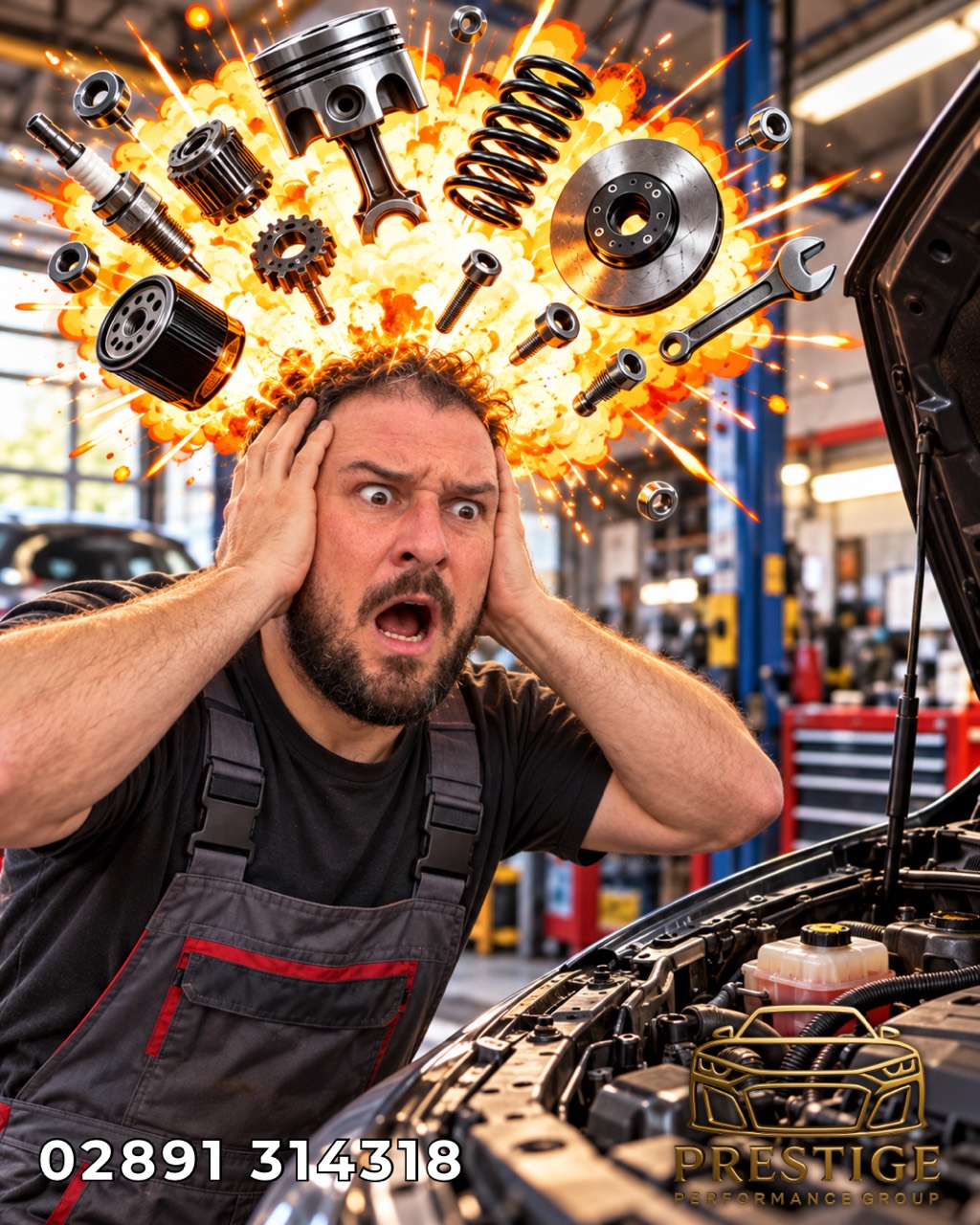
With the cost of living, fuel, insurance and vehicle ownership putting pressure on household budgets, motorists face difficult decisions. Do you spend £800 or £1,000 repairing the vehicle you own, or trade it in and spend several thousand pounds on another used car?
Could some expensive repairs have been avoided through regular servicing and preventative maintenance?
At Prestige Performance Group Ltd in Newtownards, Northern Ireland, we believe one of the biggest mistakes motorists make is treating servicing as an unnecessary expense, only to face much larger bills when something goes wrong.
Not every breakdown is caused by poor maintenance, and not every older car is worth repairing. But looking after the vehicle you already own could be one of the most sensible decisions you make. It starts with understanding what proper maintenance means.
1. Used cars aren't as cheap as they used to be
The UK used-car market has changed significantly, particularly for older, more affordable vehicles.
According to Auto Trader's August 2026 Retail Price Index report, the average advertised price of a 10–15-year-old used car reached £7,183, with like-for-like prices up 6.9% year-on-year. Cars over 15 years old recorded annual price growth of 2.6%.
In September 2026, the average asking price across the UK used-car market was £17,299. Overall like-for-like prices were down 1% year-on-year, so this does not mean every vehicle is increasing in value.
Where you once looked for a £1,500 runaround, you may now find yourself considering £3,000 or more for a suitable replacement. Even then, what are you buying?
Another used vehicle could have an incomplete service history, an overdue timing belt, worn brakes or suspension, a gearbox that has never been serviced, developing emissions faults or previous repairs and software modifications you know nothing about.
Buying another used car does not automatically mean buying a more reliable one. Sometimes a car with a known maintenance and repair history represents better value. The condition is that you actually look after it.
2. “My car needs £1,000 spent on it!”
There is a conversation that comes up in the motor trade far more often than it should.
“My car needs £1,000 spent on it. I don't know if it's worth fixing.”
“When was it last serviced?”
“It was serviced when I bought it.”
“And when was that?”
“About three years ago.”
A service carried out three years ago does not mean a vehicle has been maintained for the following three years.
Cars contain moving components, fluids, seals, filters, bearings and safety-critical systems. Those components do not stop deteriorating because the owner has not booked a service, and they do not wait until there is enough money in the household budget for repairs.
Servicing isn't something you do when the car starts running badly
Servicing is primarily preventative maintenance. Its purpose is to keep the vehicle operating correctly, maintain essential systems and create opportunities to identify developing problems.
By the time an engine makes unusual noises, a gearbox slips or a warning light has been ignored for months, you may already be dealing with a repair. That can be significantly more expensive.
3. “But I've only done 8,000 miles!”
Low mileage does not automatically mean a service can be skipped. Many schedules are based on mileage, elapsed time or calculations using operating conditions.
For numerous vehicles, routine servicing is required approximately every 12 months or at the manufacturer's mileage interval, whichever comes first. Other vehicles have different schedules, including approved longer intervals.
The correct interval is the one specified for your particular vehicle and how it is used. If maintenance is due after 12 months, covering only 8,000 miles does not remove that requirement.
Time affects a vehicle as well as mileage
A car covering 8,000 miles over a year has still been exposed to weather, moisture, temperature changes and the natural ageing of its components.
- Engine oil: condition is affected by temperature, contamination, combustion by-products and usage.
- Brakes: discs, calipers and other components can corrode, particularly on vehicles used infrequently.
- Rubber parts: hoses, seals and bushes can deteriorate without high mileage.
- Fluids: brake fluid, coolant and transmission lubricants have specific inspection or replacement requirements.
- Tyres: plenty of tread does not rule out damage or age-related deterioration.
- Batteries: repeated short journeys may not provide enough charging time.
Problems that an inspection could have identified can also develop unnoticed.
What should regular maintenance include?
Depending on the vehicle and booked service, checks can cover:
- Engine oil and appropriate filters
- Brake pads, discs, pipes, hoses and hydraulic components
- Suspension arms, joints and bushes
- Steering components
- Tyre tread, wear patterns and condition
- Coolant levels, condition and visible leaks
- Engine and gearbox oil leaks
- Belts, hoses and age-sensitive components
- Lights, wipers and other roadworthiness items
- Manufacturer-specified service and replacement intervals
Not every component is replaced at every service. Some are inspected; others are replaced at specific intervals. What matters is consistent maintenance and acting on identified defects. Low mileage is not a universal exemption.
4. An MOT is not a service
“My car passed its MOT, so everything must be fine.” Unfortunately, that is not what an MOT certificate means.
An MOT is a statutory inspection against specified roadworthiness and environmental requirements at the time of testing. In Northern Ireland, vehicle testing is administered by the Driver & Vehicle Agency.
NI Direct explains that an MOT certificate is not a substitute for regular maintenance and does not establish roadworthiness for the certificate's entire life.
An MOT does not automatically include changing oil, replacing filters, checking transmission-fluid service history or completing every manufacturer-recommended procedure. A car can pass with overdue scheduled maintenance, or develop a mechanical fault shortly afterwards.
The MOT and servicing should work together
Keep the vehicle's required MOT or applicable exemption status up to date, alongside regular servicing, safety inspections and prompt attention to defects. A test pass does not guarantee that an engine, gearbox or other mechanical system will remain reliable for the following year.
5. The cost of servicing versus the cost of repairs
At Prestige Performance Group, vehicle servicing is available for £169. Compare that with an example major repair bill:
| Maintenance example | Cost |
|---|---|
| One £169 service | £169 |
| Two annual services | £338 |
| Three annual services | £507 |
| Example major repair bill | £1,000 |
The comparison assumes the same service price each year and excludes additional manufacturer-required maintenance and repairs. It does not mean £507 of servicing would necessarily prevent a £1,000 failure: components can fail despite correct maintenance.
Regular servicing can help manage avoidable wear, maintain suitable lubrication and identify leaks, deterioration and developing defects.
Why early attention matters
An engine with a small oil leak may need a relatively straightforward repair if the problem is identified early. If the leak is ignored and the engine repeatedly runs with insufficient oil, the consequences can become considerably more serious.
The same principle applies to a coolant leak or deteriorating hose. Addressing it before overheating can avoid further damage and a substantially larger bill.
Not every problem can be predicted. The purpose of servicing is to reduce avoidable risks and maintain the vehicle throughout its life, not to guarantee that nothing will ever break.
6. Why short journeys can be hard on older vehicles
A low-mileage car does not necessarily have an easy life. Repeated short journeys may prevent an engine from reaching normal operating temperature for long enough.
Depending on the engine and usage, this can contribute to moisture or fuel contamination in oil, battery charging difficulties and problems with certain emissions systems.
Diesel particulate filters
A modern diesel's DPF captures particulate matter. Accumulated soot must periodically be reduced through regeneration.
Short journeys can make successful regeneration more difficult when the necessary conditions are not reached. Unsuccessful or interrupted regenerations may contribute to increased soot loading and related faults.
However, frequent regeneration or a DPF warning does not automatically mean the filter is faulty. Sensors, air intake components, EGR operation, engine faults and driving patterns can all be relevant.
A DPF assessment should examine the complete system before recommending cleaning or replacement. A good maintenance strategy also recognises when operating conditions are contributing to problems.
7. The expensive mistake of replacing parts without diagnosis
Some motorists question whether a car is worth keeping because they have already spent hundreds of pounds trying to repair it, yet the original problem remains.
Imagine a car with reduced power and an engine warning light. A scan identifies a boost-pressure fault. A sensor is replaced, the fault returns, another component is changed, and eventually someone recommends a turbocharger.
The customer may have spent substantial money without anyone establishing why the fault occurred.
A fault code isn't automatically a diagnosis
A diagnostic trouble code identifies a detected problem or condition outside expected parameters. It does not always identify the failed component.
An underboost code may involve the turbocharger, but an air leak, boost-control fault, vacuum problem, actuator issue or another engine fault can also be responsible.
A structured process combines fault-code information with live data, physical measurements, component tests and mechanical inspection. Some faults are straightforward; others require more investigation.
Replacing a part because it appears in a code is different from proving it is defective. Prestige's diagnostic and emissions assessments start from £120, with additional testing or repair work explained separately where required.
8. DPF problems don't always mean a new filter
A DPF warning can have several causes: excessive soot loading, a faulty differential-pressure sensor, incorrect exhaust-temperature readings, EGR problems or another engine fault disrupting regeneration.
A filter can also have physical damage or excessive non-combustible ash. These situations need different solutions.
Cleaning, regeneration and replacement are not interchangeable
Regeneration reduces combustible soot when conditions are suitable and the system is operating correctly. A suitable cleaning process may address contamination or restriction, but cannot repair a structurally damaged filter.
If the cause of repeated soot accumulation remains unresolved, the symptoms can return. The repair should follow the assessment. A DPF fault does not automatically require a new filter, but neither does every fault have a cleaning solution.
9. ECU and electronic module faults: repair may be possible
Modern vehicles contain control units for engine management, body electronics, security, transmissions and other systems. A manufacturer's replacement module can represent a significant cost.
Depending on the fault, alternatives may include testing, repair, cloning or a compatible replacement. Prestige supports ECU, BCM, BSI and other applicable modules.
Does a failed ECU always need replacing?
No. Some faults can be repaired at component or circuit-board level. In other cases, a compatible used ECU may be practical. Where supported, cloning can transfer necessary data from the original to a replacement.
Not every unit is repairable or clonable. Some replacements need additional coding or security programming. Confirm the actual fault, part numbers and compatibility before purchasing a module. See our ECU and electronic module services.
10. When is an older car worth repairing?
Consider a generally reliable 2013 family car that needs an £800 repair. An alternative used vehicle costs £4,500:
| Consideration | Existing car | Replacement car |
|---|---|---|
| Immediate repair or purchase | £800 | £4,500 |
| Additional initial maintenance | £0 assumed | £250 assumed |
| Initial cash outlay | £800 | £4,750 |
This is an illustrative scenario, not a quotation or a complete ownership-cost calculation. It excludes trade-in value, future maintenance, depreciation, insurance, finance and other costs.
The difference in immediate spending is £3,950. That does not prove repairing is £3,950 cheaper overall, because the replacement also has an asset value.
But if your existing car is mechanically sound, structurally healthy and well maintained, an £800 repair may represent good value, especially compared with another similarly aged car of unknown history.
Knowing your vehicle's history has value
After several years of ownership, you may know when the car was serviced, whether its timing belt was replaced, which repairs are complete, whether it uses oil or coolant, how the gearbox behaves and whether recurring faults were resolved.
You may not know those things about a replacement. Some problems will not be obvious during a viewing or short test drive.
11. When is it better to replace the vehicle?
There are circumstances where more investment makes little sense. Extensive structural corrosion, multiple major failures, serious safety concerns or persistent reliability problems can make replacement the better option.
Assess the overall condition. A car needing an £800 repair may be worth keeping if everything else is healthy. If it also needs extensive welding, a gearbox, suspension repairs and major engine work, the decision looks different.
Don't fall into the sunk-cost trap
Money already spent does not automatically justify spending more. If you spent £2,000 last year, that money has gone.
Base each new decision on present condition, the likelihood of a successful repair and the cost of alternatives. Sometimes repair is right; sometimes replacement is right; sometimes further assessment is needed first.
12. Buying another car doesn't remove the need for maintenance
If an older car developed expensive problems after years of neglected maintenance, what happens when you buy another one? Do you maintain it, or drive until another warning light appears?
A used-car purchase should begin with reviewing the maintenance history and identifying outstanding work. That may include an engine service, brake inspection, fluid changes or time-sensitive maintenance.
“It was serviced before you bought it” does not remove the need to follow the next interval.
Want to keep your car for another five years?
- Follow the manufacturer's service schedule and maintenance reminders.
- Have brakes, tyres, suspension and other safety-critical parts inspected.
- Address fluid leaks and warning lights promptly.
- Check timing-belt and transmission maintenance requirements.
- Do not ignore time-based maintenance because mileage is low.
The aim is to keep the car in good condition, not simply keep it running until something fails.
13. Professional vehicle servicing in Newtownards: £169
Prestige Performance Group encourages motorists to take a proactive approach. Our £169 vehicle service offers an opportunity to arrange regular maintenance rather than wait for problems.
Servicing should be considered alongside the manufacturer's schedule and the car's age, mileage, condition and usage. The operations, parts and inspections depend on the booked service specification. Additional scheduled maintenance or repairs may be needed and should be quoted separately.
Our specialist services also include:
- Vehicle diagnostics: investigation of warning lights, performance issues and electrical or mechanical faults.
- DPF and emissions assessments: testing to establish system condition and identify the cause of faults.
- ECU and electronic module services: testing, repair, cloning and suitable replacement options.
- Automatic transmission servicing: appropriate fluid servicing for supported gearboxes and vehicles.
Our objective is to help customers make informed decisions. We would rather see a vehicle maintained correctly than its owner facing an expensive problem that could have been identified earlier.
14. Five questions every motorist should ask
- When was the vehicle last properly serviced? Not when it passed its MOT or when you purchased it: when was the relevant scheduled maintenance completed?
- Has the fault been diagnosed correctly? Has testing established the cause, or are parts being replaced on assumptions?
- What other work does the vehicle need? One repair quote does not always tell the whole story.
- What would a suitable replacement cost? Compare realistic alternatives with similar suitability and better overall condition.
- Am I deciding on facts or frustration? Replacing a vehicle in frustration can turn one repair bill into a larger commitment.
The cheapest car might be the one you already own
For many motorists, maintaining and repairing an existing car may be the sensible option. There is a difference between keeping it maintained and driving until something fails.
Servicing is not an optional luxury because a car is older. Regular maintenance and inspections become increasingly important as vehicles age.
Covering only 8,000 miles does not automatically mean maintenance can be skipped. Passing an MOT does not mean every service item has been addressed. An expensive repair does not automatically mean a vehicle is not worth repairing.
What matters is knowing its condition, understanding the fault and making informed decisions about where to spend your money.
At Prestige Performance Group, we believe in maintaining vehicles properly, diagnosing faults accurately and recommending appropriate repairs. Sometimes the biggest cost is the neglected maintenance, the wrong parts or the repairable car you gave up on.
Book your vehicle service or diagnostic assessment
Prestige Performance Group Ltd
Newtownards, County Down, Northern Ireland
Vehicle servicing: £169. Specialist diagnostics, DPF assessments, ECU and electronic module repairs, and automatic transmission services are also available.
Assessment First. Diagnose Properly. Fix It Right.