
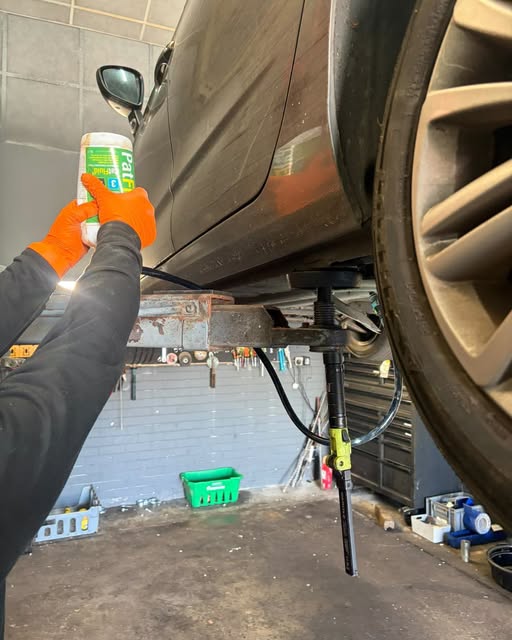
A recent vehicle arrived at Prestige Performance Group with a DPF-related warning on the dashboard. In this case, the work was straightforward: one litre of particulate-filter additive was added to the tank, the required diagnostic resets were completed and the warning lights went out.
The identified issue was the additive supply. It did not call for DPF removal or a software bypass.
This case highlights a part of diesel emissions control that many drivers have never heard of: PAT fluid, also commonly referred to as Eolys or particulate-filter additive.
PAT fluid at a glance
- Some diesel vehicles use an onboard additive system to support DPF regeneration.
- The additive is stored separately and automatically dosed into the diesel fuel.
- It helps collected soot burn off at a lower temperature.
- Eolys is a recognised family of fuel-borne catalyst additives.
- The correct fluid specification depends on the vehicle application.
- A refill may require diagnostic service procedures as well as the physical work.
- A low-additive warning and a blocked-filter warning are different conditions.
- Refilling additive does not physically remove ash or repair a damaged DPF.
What is PAT fluid?
PAT fluid is a term commonly used for particulate-filter additive. Eolys is a branded range of additives used in this type of system.
Its technical description is a fuel-borne catalyst. The additive travels through the fuel and combustion process, helping the soot subsequently collected in the filter burn off more readily during regeneration.
This is part of the vehicle designed emissions-control strategy. The vehicle meters the additive through its own system; the driver does not routinely pour it into the diesel tank.
How an additive-assisted DPF works
The DPF traps soot from the engine exhaust. To keep functioning, it must periodically burn off accumulated soot through regeneration.
On an additive-assisted system, a small quantity of the specified additive is introduced into the diesel fuel. This helps lower the temperature needed to burn the soot retained in the filter.
The additive supply is therefore one part of the complete regeneration process. Exhaust temperatures, engine operation and control-system information still matter.
Which vehicles use Eolys or DPF additive?
Additive-assisted particulate filters are associated with certain Peugeot, Citroen and DS diesel applications. Related systems also appear in selected vehicles from other manufacturers.
The badge, engine designation or registration year alone should not be used to select a refill product. The useful questions are whether the specific vehicle has an additive-assisted particulate filter, which additive specification applies, what reservoir or pouch arrangement is fitted and which service procedure is required.
Eolys, AdBlue and bottled DPF cleaner are different
| Product | Main purpose | How it is used |
|---|---|---|
| PAT fluid / Eolys | Supports soot combustion during DPF regeneration | Metered from a dedicated onboard additive supply into the diesel fuel |
| AdBlue | Supports reduction of nitrogen-oxide emissions through SCR | Dosed into the exhaust system from its own dedicated tank |
| Aftermarket fuel-system or DPF cleaner | Provides the treatment described by its manufacturer | Used according to the product instructions and vehicle compatibility |
Adding AdBlue will not replenish the particulate-filter additive reservoir. A bottled DPF-cleaning product does not replace the correct fluid in an onboard Eolys system. Some diesel applications have both systems, each with its own servicing requirements.
What does particle filter additive level too low mean?
An explicit low-additive message directs attention towards the additive supply and its monitoring. It should not immediately be interpreted as proof that the filter needs cleaning or replacement.
Dashboard wording varies between models. Photographing the full message helps the workshop identify the appropriate investigation.
What happens if the additive supply runs low?
The additive system is intended to support regeneration. If the required supply is unavailable, that assistance can be compromised.
However, a low-additive warning does not tell us how restricted the filter currently is. Additive status tells us about the supply needed by the system. Filter condition tells us whether soot, ash or physical damage requires additional attention.
What an Eolys refill and reset involves
The physical refill is only part of the service. The workshop needs to identify the correct fluid, establish the appropriate quantity and complete the service operations applicable to that vehicle.
- Confirm the warning and system fitted.
- Identify the fluid specification.
- Inspect the relevant components.
- Carry out the refill or reservoir service.
- Complete the applicable diagnostic operations.
- Check the result after the procedure.
Our recent workshop example
On the job that prompted this article, we added one litre of the appropriate additive, performed the required resets and confirmed the warning lights were out.
One litre was the quantity used on that vehicle. It is not a universal refill recommendation.
Why a refill reset is different from clearing fault codes
Clearing fault codes removes diagnostic records where the control unit permits it. A service reset or refill procedure has a different purpose: completing the control-system operations associated with the work carried out.
An additive refill should not become a reason to declare that the DPF itself has been replaced. Likewise, resetting a filter-related value does not physically remove deposits.
What if the warning returns after a refill?
First establish whether it is the same warning and the same recorded fault. Further investigation may need to distinguish between an incomplete service procedure, a supply or leakage issue, a delivery-system concern, an electrical fault or a separate particulate-filter condition.
Does an additive refill remove soot and ash?
Refilling restores the specified additive supply. It does not directly flush deposits out of the filter.
The system uses the additive to assist soot combustion during subsequent regeneration. Ash is different. It remains after soot burns and cannot be removed by regeneration.
An additive refill, a regeneration, a professional clean and a filter replacement are distinct operations. Each needs a reason. For more on establishing filter condition, see our DPF assessment service in Northern Ireland.
Can a motorway drive clear a low-additive warning?
A regeneration drive may be advised for a particular soot-loading warning when the vehicle handbook specifies it. It cannot replenish an additive reservoir.
Follow the instructions for the exact warning displayed. If you are unsure which condition the message describes, contact the workshop before attempting to drive it clear.
PAT fluid and Eolys enquiries in Northern Ireland
Prestige Performance Group is based in Newtownards, supporting drivers and independent workshops from Bangor, Comber, Belfast and across Northern Ireland.
If your dashboard displays a low particulate-filter additive warning, send us your registration, a photograph of the message, any relevant fault codes or diagnostic report and details of previous additive, DPF or AdBlue work.
Assessment First. Diagnose Properly. Fix It Right.
Start with our DPF assessment service if the cause is uncertain, or contact us to confirm the appropriate booking.